
A joint venture of NK'Mip Forestry and Infinity-Pacific Stewardship Group
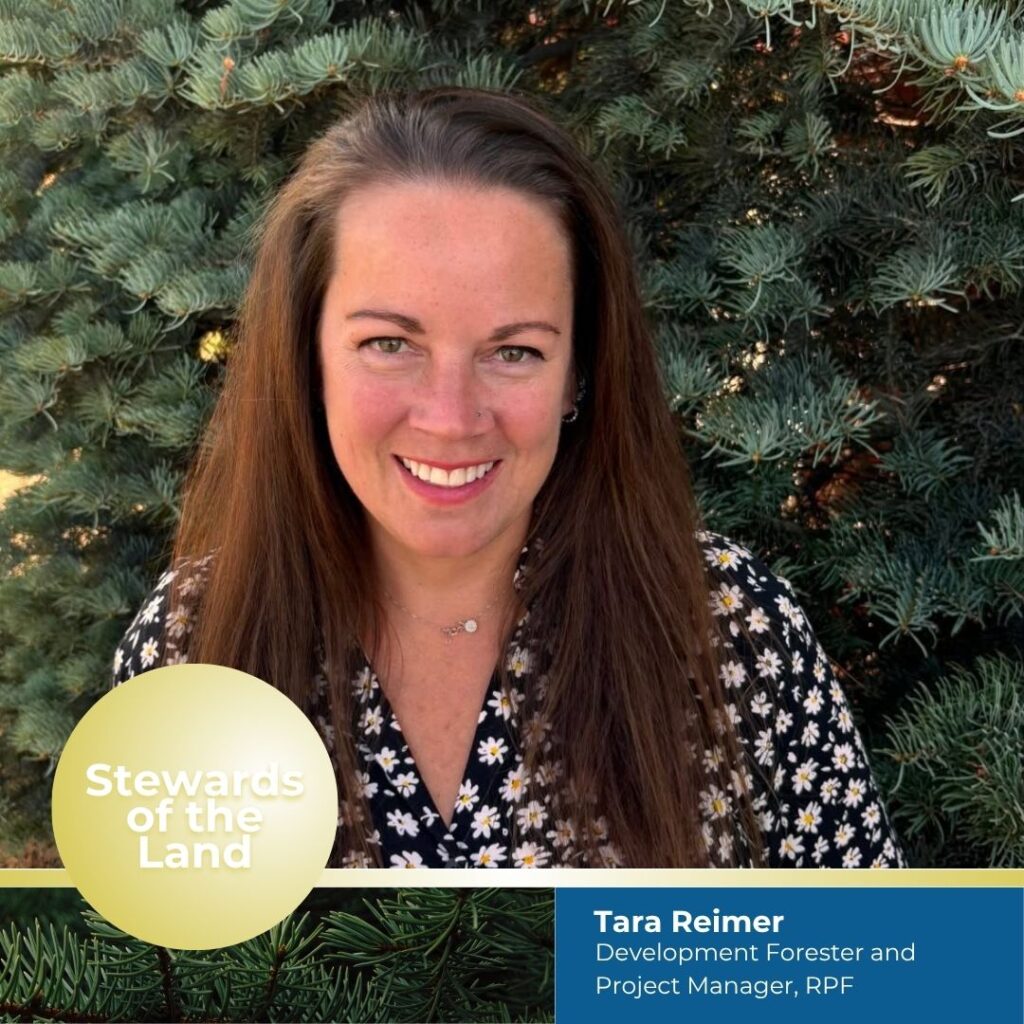
Tara Reimer is a Registered Professional Forester working with the Osoyoos Indian Band and Siya Forestry. Originally from Birds Hill, Manitoba, Tara is of First Nations Cree descent and has worked across southern Manitoba and British Columbia in government, industry and consulting.
For Tara, a career in forestry grew from something simple: she always wanted to be outside. Summer jobs that kept her outdoors eventually led her to study Geography and Environmental Studies at the University of Winnipeg, followed by the Forest Technician Program at Selkirk College and a Bachelor of Science in Natural Resources with a major in Forestry from the University of Northern British Columbia. She later earned her Registered Professional Forester designation.
“I didn’t know much about forestry as a profession before I chose it,” Tara said. “I just knew I was drawn to it academically, personally, and wanted to learn more.”
Today, Tara is one of the foresters working with OIB. She supports permit development on OIB’s Non-Replaceable Forest Licences from planning through submission, coordinates with specialists, harvest supervisors, and works through Siya Forestry as an RPF on projects for other licence holders.
“We balance so many different goals, objectives and values, and we are always learning,” she said. “I really feel like we are a team moving forward, doing right by the forest, with OIB values as our guiding principles.”
One project Tara is especially proud of involved developing a permit for OIB’s woodlot on the Osoyoos Indian Band Reserve. The work required navigating federal, provincial and Band requirements while incorporating OIB values into the plan.
“No one we reached out to had done this sort of permitting process before,” she said. “We worked closely with Vern Louie, Forestry Operations Lead for Osoyoos Indian Band, on the field layout of this project to ensure OIB values were reflected on the ground, and it was really rewarding.”
Another project showed why field observations matter. An area that was initially rated as having very low habitat suitability for sapsuckers was found to have the birds present. A sapsucker is a type of North American woodpecker known for drilling neat rows of small holes in trees to feed on tree sap. Prior to harvest, Tara developed a plan that accounted for the sapsuckers’ current use of the area. Tara worked with the harvest supervisor to ensure habitat targets would be met during operations.
“Take the time to notice what the forest is telling you,” Tara said. “People, animals, water and vegetation all need something different from it, and it is important to consider and balance those needs when developing plans.”
She says people outside forestry may not realize how much goes into a single plan. Roads, soils, fish, water, wildlife, biodiversity, cultural values and legal requirements can all shape decisions before harvesting begins.
“There is never a dull day. There is always something to figure out, learn and decisions to make,” shared Tara.
Some of Tara’s most rewarding moments have been simple ones, including hearing Vern say she had helped him learn more about fish breaks and riparian features, an area she especially values. She is also proud to take on new challenges and take the initiative to learn new things throughout her career.
“We are not the boss of nature. Nature is the boss of us,” Tara said.
After years in the profession, Tara still approaches forestry with curiosity and a willingness to learn. For her, doing the work well means understanding the rules, paying attention to the land and finding ways to work with the forest rather than trying to control it.
